How Big Is Tick Data? File Sizes by Timeframe
The first tick download surprises everyone. A decade of daily candles is a file your email could carry; the same decade in ticks is tens of gigabytes. This guide puts real numbers on that gap — so you can size a download before you start it, not after it fills the disk.
Get the app — €9 →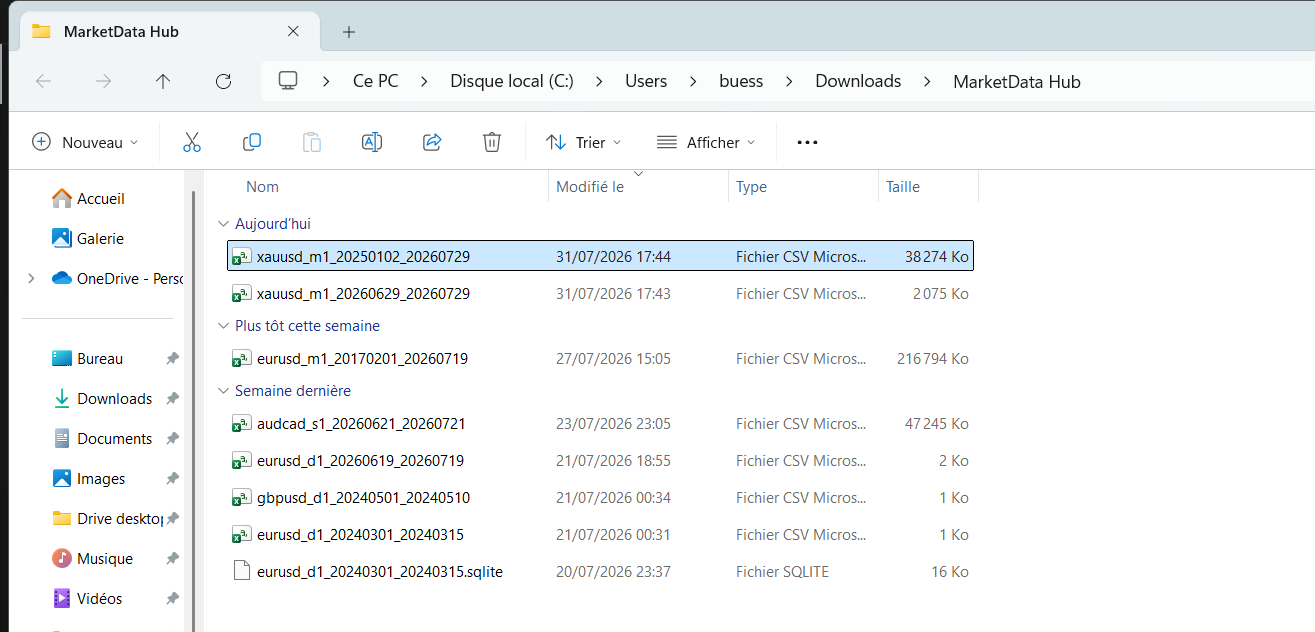
The rule of thumb
A CSV row of market data — timestamp plus prices — weighs roughly 40–50 bytes. A real 4.8-million-row export from the MarketData Hub client measures 181 MB on disk, about 40 bytes a row. So the only question that matters is: how many rows does your timeframe produce? That is where the factor-of-a-million spread comes from: one instrument-year is a few hundred daily candles, a few hundred thousand 1-minute candles, or tens of millions of ticks.
Worked example: EUR/USD
EUR/USD trades roughly 24 hours, five days a week. Its full history, timeframe by timeframe:
| Timeframe | History from | Approx. rows | Approx. CSV |
|---|---|---|---|
| Tick (every quote) | 2003-05-04 | very large | — |
| 1 second | 2003-05-04 | very large | — |
| 1 minute | 2003-05-04 | ~8.5M | ~423 MB |
| 5 minutes | 2003-05-04 | ~1.7M | ~85 MB |
| 15 minutes | 2003-05-04 | ~564K | ~28 MB |
| 30 minutes | 2003-05-04 | ~282K | ~14 MB |
| 1 hour | 2003-05-04 | ~141K | ~7 MB |
| 4 hours | 2003-05-04 | ~35,300 | ~2 MB |
| Daily | 1973-03-01 | ~13,500 | ~674 KB |
| Monthly | 1973-03-01 | ~640 | ~32 KB |
Worked example: BTC/USD
Bitcoin never closes — 24 hours, seven days — so per year it produces about 40% more candles than a forex pair at the same timeframe, despite its shorter history:
| Timeframe | History from | Approx. rows | Approx. CSV |
|---|---|---|---|
| Tick (every quote) | 2017-05-07 | very large | — |
| 1 second | 2017-05-07 | very large | — |
| 1 minute | 2017-05-07 | ~4.9M | ~245 MB |
| 5 minutes | 2017-05-07 | ~980K | ~49 MB |
| 15 minutes | 2017-05-07 | ~327K | ~16 MB |
| 30 minutes | 2017-05-07 | ~163K | ~8 MB |
| 1 hour | 2017-05-07 | ~81,600 | ~4 MB |
| 4 hours | 2017-05-07 | ~20,400 | ~1 MB |
| Daily | 2017-05-07 | ~3,400 | ~170 KB |
| Monthly | 2017-05-07 | ~110 | ~6 KB |
Why tick rows are "very large" instead of a number
Candle counts follow from session hours, so they can be estimated honestly. Tick counts can't: they follow from activity, which varies by orders of magnitude between a quiet Asian session and a payrolls release. As an order of magnitude, an active major produces tens of millions of quotes a year — roughly 1–2 GB per year as CSV, more in volatile years. Treat any precise-sounding tick estimate with suspicion, ours included; the honest answer is a range.
How to keep downloads manageable
- Use the coarsest timeframe that answers your question. Most backtests don't need ticks — see tick data vs OHLC for when each is right. Dropping from tick to 1-minute cuts the size by roughly two orders of magnitude and loses nothing a candle-based strategy can use.
- Slice tick ranges. Fetch a year at a time rather than the whole archive in one job. The client queues long runs and resumes them if interrupted, but smaller files are also simply easier to work with afterwards.
- Prefer columnar formats for big series. CSV is the universal interchange; it is also the bulkiest. The Pro licence writes Parquet — typically several times smaller than the same data as CSV, and dramatically faster to query (see querying market data with SQL). JSON goes the other way: repeating the key names on every row makes it the largest option, so keep it for small extracts.
- Know your tool's ceiling. Excel stops at 1,048,576 rows — decades of daily data, a couple of years of 1-minute, no ticks at all (see the spreadsheet guide). pandas wants the working set in RAM; count on several times the on-disk CSV size once parsed.
Nothing here is priced by size
One thing file size does not affect: cost. The MarketData Hub client fetches on your own machine, straight from the source — there is no metering, no per-gigabyte charge, and no tier that unlocks "more" data. A €9 licence downloads the same ticks a €40 one does; higher tiers change export formats and automation, never volume. Check any instrument's page — every one lists its own per-timeframe row and size estimates, like gold or the US 500.
Frequently asked questions
- How big is forex tick data?
- Roughly 1–2 GB per instrument-year as CSV for an active major pair, at 40–50 bytes per quote — but it varies widely with market activity. A full multi-decade tick archive for one pair runs to tens of gigabytes.
- How big is 1-minute historical data?
- A 24×5 instrument produces about 360,000 one-minute candles a year — roughly 18 MB as CSV. Twenty years is around 7 million rows and 350 MB: large for a spreadsheet, trivial for pandas or a database.
- How many bytes is a row of market data?
- About 40–50 bytes as CSV for a timestamped OHLC or tick row. A measured 4.8-million-row export weighs 181 MB, almost exactly 40 bytes per row.
- Does downloading more data cost more?
- Not here. The software licence is a one-time purchase and retrieval runs on your own machine, so there is no per-download or per-gigabyte charge. Every licence tier reaches the full history of every instrument.
Related markets
- Crypto historical data · 33 instruments