Germany 40 (DAX) Historical Data Downloader
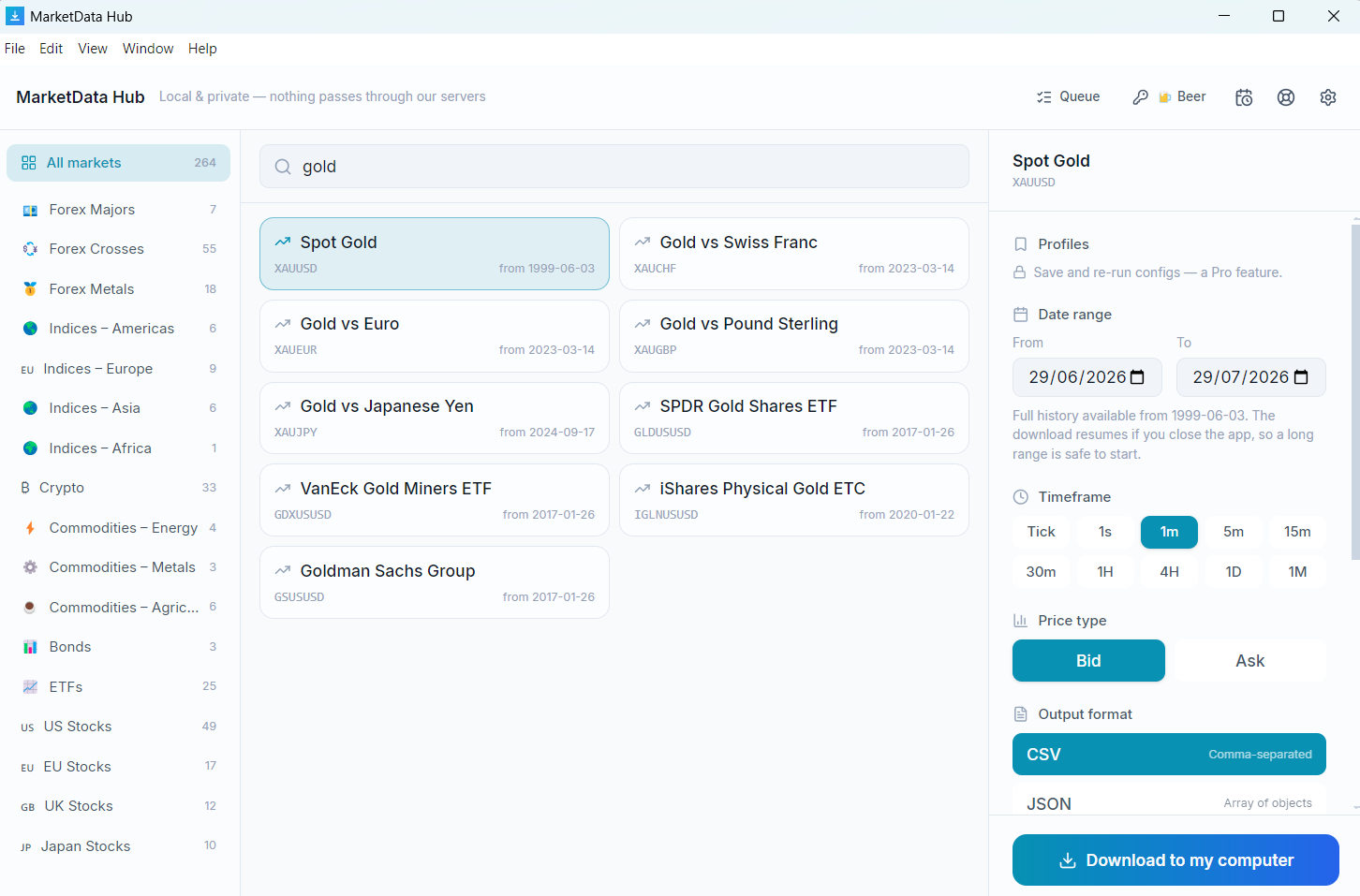
A desktop app that downloads Germany 40 (DAX) (DEUIDXEUR) price history on your own machine, written straight to your disk as CSV or JSON. History runs from 2013-01-01 — around 13 years — at every timeframe from raw ticks to monthly candles. A complete Germany 40 (DAX) 1-minute series is roughly 4.7M rows, about 234 MB as CSV.
Preview a Germany 40 (DAX) download →Or work out the size first: the file-size calculator takes a range and returns the row count and CSV size.
Windows, macOS, Linux · €9 one-time for the entry licence · get the app
What the app fetches for Germany 40 (DAX)
| Symbol | DEUIDXEUR |
|---|---|
| Instrument | Germany 40 (DAX) |
| Asset class | Indices – Europe |
| Tick & 1-second data from | 2013-01-01 |
| 1–30 minute candles from | 2013-09-30 |
| Hourly & 4-hour candles from | 2013-09-30 |
| Daily & monthly candles from | 2013-09-30 |
| Timeframes | Tick → 1s → 1m → 5m → 15m → 30m → 1h → 4h → Daily → Monthly |
| Price types | Bid & Ask |
| File formats | CSV, JSON (MetaTrader, NinjaTrader, Parquet & SQLite/DuckDB from the Pro licence) |
| Coverage | 2013-01-01 → 2026-09-17 (last completed trading day) |
| Retrieval | Local — your machine connects directly to Dukascopy Bank SA |
| Runs on | Windows, macOS, Linux |
Germany 40 (DAX) timeframes the app supports
- Tick (every quote)
- 1 second
- 1 minute
- 5 minutes
- 15 minutes
- 30 minutes
- 1 hour
- 4 hours
- Daily
- Monthly
Germany 40 (DAX) coverage & file size, timeframe by timeframe
Every Germany 40 (DAX) timeframe shares the same 2013-01-01 start date, but not the same scale — coarser candles stay small while tick and intraday files grow fast. Current through 2026-09-17:
| Timeframe | History from | Approx. rows | Approx. CSV |
|---|---|---|---|
| Tick (every quote) | 2013-01-01 | very large | — |
| 1 second | 2013-01-01 | very large | — |
| 1 minute | 2013-09-30 | ~4.7M | ~234 MB |
| 5 minutes | 2013-09-30 | ~938K | ~47 MB |
| 15 minutes | 2013-09-30 | ~313K | ~16 MB |
| 30 minutes | 2013-09-30 | ~156K | ~8 MB |
| 1 hour | 2013-09-30 | ~78,100 | ~4 MB |
| 4 hours | 2013-09-30 | ~19,500 | ~977 KB |
| Daily | 2013-09-30 | ~3,300 | ~163 KB |
| Monthly | 2013-09-30 | ~160 | ~8 KB |
Counts are approximate, derived from index session hours across the available history. Tick and 1-second runs are queued and resumable rather than fetched in one pass. See the data methodology for how candles are built.
Working with the Germany 40 (DAX) series
The DAX is unusual among major indices in being a performance index: dividends are treated as reinvested and are already in the level. Comparing it directly against price-return indices like the S&P 500 or FTSE 100 therefore overstates German outperformance — you are comparing total return against price return. Correct for this before drawing cross-market conclusions. Coverage begins 2013.
Germany 40 (DAX) data by timeframe — what the archive actually holds
DAX 1-minute historical data (M1)
The 1-minute series is aggregated from ticks and starts 2013-01-01. The full run to today is 4.7M rows, about 234 MB as CSV — comfortably a pandas or DuckDB file, not a spreadsheet. What surprises people first: it contains rows outside the 09:00–17:30 CET Xetra session, because this is the source's index CFD quote and it is quoted well beyond cash-market hours. If your strategy is meant to trade the cash index, filter to the Xetra session yourself; the app does not, because it does not know which hours you consider "the market".
DAX tick data
Tick rows are bid and ask quotes with a millisecond UTC timestamp — there is no exchange volume column, because a CFD quote stream is not the Xetra order book. Tick history begins 2013-01-01, which is earlier than the daily archive (2013-09-30) — the reverse of the forex majors, where ticks start decades after daily candles. If you need the months before 2013-09-30 at daily resolution, fetch ticks or 1-minute and aggregate them. A full tick download is a queued, resumable job rather than a single fetch.
DAX daily OHLC — and why the close is not Xetra's close
Daily candles start 2013-09-30 and the whole history is 3,300 rows, about 163 KB as CSV — a one-minute download. Every candle boundary in the file is UTC midnight, not the 17:30 CET Xetra closing auction, so the "close" column is the last CFD quote before midnight, not the official DAX settlement value. Studies that compare this file's closes against published DAX closes will see small, systematic differences; that is the boundary, not an error in the data. If you need candles that end at the Xetra close, build them from the 1-minute file with your own session cut.
DAX 30 or DAX 40? What the 2021 expansion means for this series
Deutsche Börse widened the index from 30 to 40 constituents on 20 September 2021. It is one continuous series — the level did not jump — but anything you fit before that date was fitted to a 30-name index with a different sector mix, and the same holds for constituent-level studies. And because the archive begins in 2013, there is no 2008 and no 2011 in it: a DAX drawdown study built here is a study of the post-2013 regime only.
DAX, DAX 40, GER40, DE40, Germany 40 — one series, five names
Brokers and charting platforms label the same index CFD differently; the source calls it Germany 40 (DEUIDXEUR). Whatever your platform calls it, this is the file: a euro-denominated quote of the index, tick to monthly, written to your disk. Every licence tier reaches all of it — there is no date range or timeframe behind a higher tier, and the app is a free download. See what each tier changes.
What's inside the Germany 40 (DAX) file
timestamp,open,high,low,closeOne row per candle; tick files instead carry timestamp,bid,ask on every quote. All timestamps are UTC. Worked examples and import steps are in the CSV & JSON format guide.
About Germany 40 (DAX)
Germany 40 (DAX) (DEUIDXEUR) is a stock-index CFD with 13 years of retrievable history. It is commonly used for backtesting index and CFD strategies, studying long-term market cycles and drawdowns, benchmarking portfolios and building quantitative research datasets. Pick any date range from 2013-01-01 onward, choose a timeframe and the bid or ask side, and the app fetches and writes the files locally — no scripting.
Frequently asked questions
- How far back does Germany 40 (DAX) data go?
- Germany 40 (DAX) history runs from 2013-01-01 — roughly 13 years — up to the last completed trading day, at every timeframe from raw ticks to monthly candles. Every licence tier reaches all of it.
- How large is a full Germany 40 (DAX) download?
- The complete Germany 40 (DAX) 1-minute history is roughly 4.7M rows, about 234 MB as CSV. Daily candles over the same instrument are far smaller — around 3,300 rows, 163 KB. Tick and 1-second runs are larger again and are queued and resumable rather than fetched in one pass. Sizes are approximate; nothing is priced by volume.
- What columns are in the Germany 40 (DAX) CSV file?
- OHLC files contain a timestamp plus open, high, low and close columns; tick files contain a timestamp with bid and ask prices. All timestamps are UTC. The files import directly into Excel, Google Sheets, Python (pandas read_csv), R, MetaTrader, NinjaTrader and TradingView.
- Do you sell Germany 40 (DAX) data?
- No — we sell software. The MarketData Hub client retrieves Germany 40 (DAX) (DEUIDXEUR) on your own machine, under your instruction, directly from the source; we never host, cache or relay it. Your use of the retrieved data is subject to the source's terms.
Guides
- Get the app — Windows, macOS, Linux
- How to download historical index data
- CSV & JSON format — columns explained
- Tick data vs OHLC candles
- Backtesting with historical data
- Excel & Google Sheets
- How far back data goes
Related Indices – Europe
- France 40 (CAC 40)
- Europe 50 (Euro Stoxx 50)
- UK 100 (FTSE 100)
- Spain 35 (IBEX 35)
- Switzerland 20 (SMI)
- Italy 40 (FTSE MIB)
- Netherlands 25 (AEX)
- Poland 20 (WIG20)
Preview your Germany 40 (DAX) download — pick a range, see the exact file →
Sizing it up rather than fetching it? Estimate Germany 40 (DAX) rows and CSV size for any date range.
The preview runs in the browser; the download runs in the free desktop app, on your machine.