USD/JPY Historical Data Downloader
A desktop app that downloads US Dollar vs Japanese Yen (USD/JPY) price history on your own machine, written straight to your disk as CSV or JSON. Daily and monthly USD/JPY candles reach back to 1986-02-10 — around 40 years — while quote-level tick history begins 2003-05-04. A complete USD/JPY 1-minute series is roughly 8.5M rows, about 426 MB as CSV.
Or work out the size first: the file-size calculator takes a range and returns the row count and CSV size.
Windows, macOS, Linux · €9 one-time for the entry licence · get the app
What the app fetches for USD/JPY
| Symbol | USD/JPY |
|---|---|
| Instrument | US Dollar vs Japanese Yen |
| Asset class | Forex Majors |
| Tick & 1-second data from | 2003-05-04 |
| 1–30 minute candles from | 2003-05-04 |
| Hourly & 4-hour candles from | 2003-05-04 |
| Daily & monthly candles from | 1986-02-10 |
| Timeframes | Tick → 1s → 1m → 5m → 15m → 30m → 1h → 4h → Daily → Monthly |
| Price types | Bid & Ask (with volume) |
| File formats | CSV, JSON (MetaTrader, NinjaTrader, Parquet & SQLite/DuckDB from the Pro licence) |
| Coverage | 1986-02-10 → 2026-11-02 (last completed trading day) |
| Retrieval | Local — your machine connects directly to Dukascopy Bank SA |
| Runs on | Windows, macOS, Linux |
USD/JPY timeframes the app supports
- Tick (every quote)
- 1 second
- 1 minute
- 5 minutes
- 15 minutes
- 30 minutes
- 1 hour
- 4 hours
- Daily
- Monthly
USD/JPY coverage & file size, timeframe by timeframe
USD/JPY does not start at the same date at every granularity: daily candles begin 1986-02-10, but the tick archive only reaches 2003-05-04, roughly 17 years later. Each row below gives that timeframe's own start date and scale, current through 2026-11-02:
| Timeframe | History from | Approx. rows | Approx. CSV |
|---|---|---|---|
| Tick (every quote) | 2003-05-04 | very large | — |
| 1 second | 2003-05-04 | very large | — |
| 1 minute | 2003-05-04 | ~8.5M | ~426 MB |
| 5 minutes | 2003-05-04 | ~1.7M | ~85 MB |
| 15 minutes | 2003-05-04 | ~568K | ~28 MB |
| 30 minutes | 2003-05-04 | ~284K | ~14 MB |
| 1 hour | 2003-05-04 | ~142K | ~7 MB |
| 4 hours | 2003-05-04 | ~35,500 | ~2 MB |
| Daily | 1986-02-10 | ~10,300 | ~513 KB |
| Monthly | 1986-02-10 | ~490 | ~24 KB |
Counts are approximate, derived from forex session hours across the available history. Tick and 1-second runs are queued and resumable rather than fetched in one pass. See the data methodology for how candles are built.
Working with the USD/JPY series
USD/JPY is quoted to three decimal places rather than five, so a pip is 0.01 and not 0.0001 — a detail that silently breaks position-sizing and spread calculations ported from a EUR/USD script. The pair is also the classic carry-trade vehicle, which means its drawdowns cluster: long quiet trends punctuated by violent unwinds. Backtests tuned on the trending stretches tend to look far better than they should.
USD/JPY historical data by timeframe
USD/JPY tick and 1-minute data
Both start 2003-05-04. The full 1-minute series is 8.5M rows, about 426 MB as CSV; ticks are a queued, resumable job. Daily candles reach further back, to 1986-02-10, and the whole daily history is 10,300 rows, about 513 KB as CSV.
Intervention days — in the data, and easy to clean away
Japan's Ministry of Finance bought yen on 22 September 2022, its first intervention to support the currency since 1998, and has intervened several times since, including late April and early May 2024; in early August 2024 the unwinding of yen carry trades moved the pair just as violently. All of it falls inside the tick era, so every quote of those sessions is in the file. Those are also exactly the bars a generic outlier filter flags. If your cleaning step drops "impossible" moves, check what it did on those dates before trusting the result — a carry strategy backtested without them looks far safer than it was.
Is USD/JPY historical data free?
The app is a free download and the data comes straight from Dukascopy Bank SA to your disk, never through our servers. Every licence, including the €9 entry tier, reaches the whole USD/JPY archive at every timeframe — tiers differ by software features, never by history.
What's inside the USD/JPY file
timestamp,open,high,low,close,volumeOne row per candle, stamped with the bar's opening time; tick files instead carry timestamp,askPrice,bidPrice,askVolume,bidVolume on every quote — ask first. Timestamps are epoch milliseconds in UTC, which pd.to_datetime(df.timestamp, unit="ms", utc=True) or =A2/86400000+DATE(1970,1,1) turns into a date. Worked examples and import steps are in the CSV & JSON format guide.
About US Dollar vs Japanese Yen
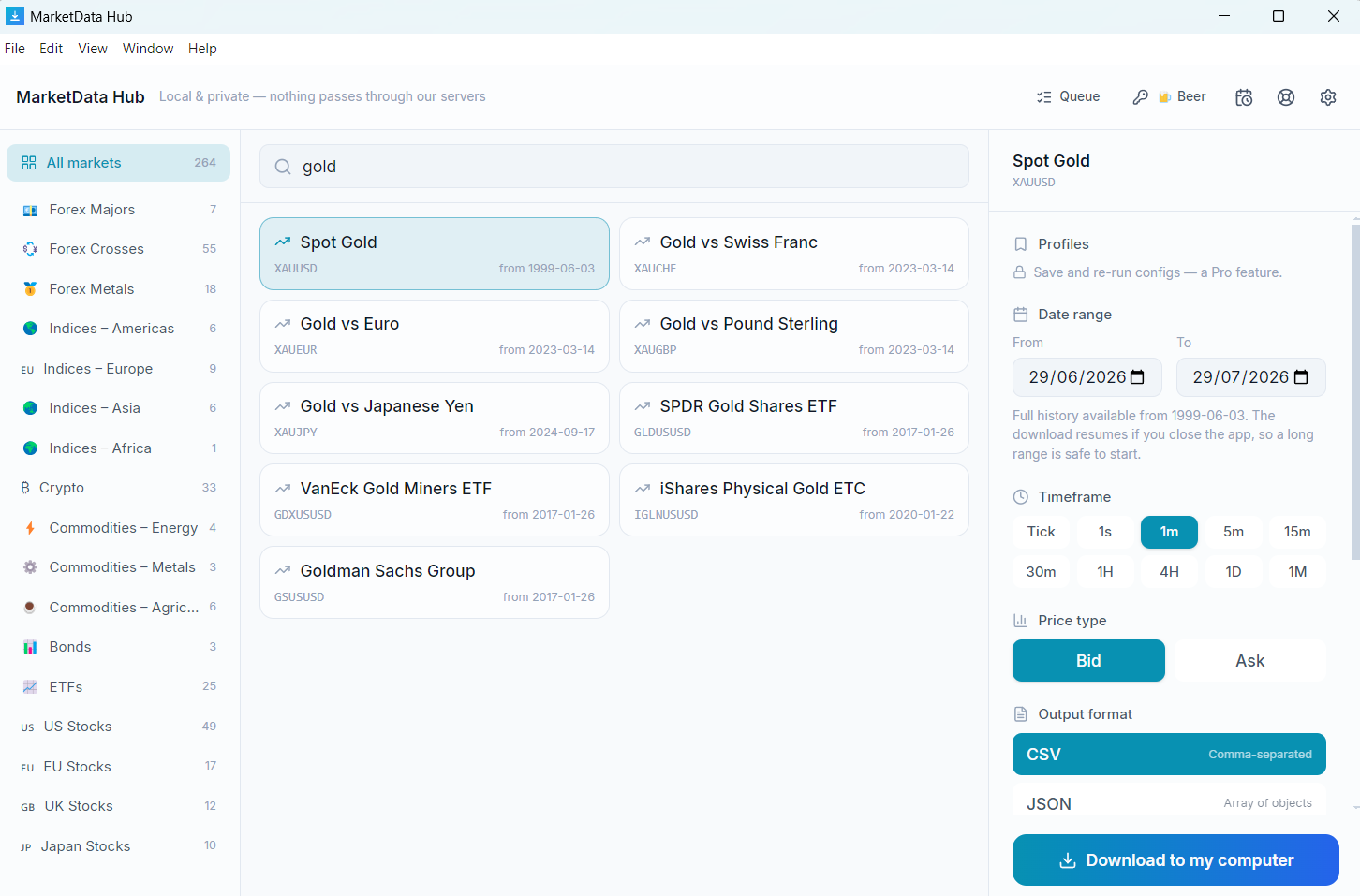
US Dollar vs Japanese Yen (USD/JPY) is a spot forex pair with 40 years of retrievable history. It is commonly used for backtesting forex trading strategies and expert advisors (EAs), spread and volatility analysis, training algorithmic and machine-learning models, and charting currency-pair history. Pick any date range from 1986-02-10 onward, choose a timeframe and the bid or ask side, and the app fetches and writes the files locally — no scripting.
Frequently asked questions
- How far back does USD/JPY data go?
- USD/JPY daily and monthly candles reach back to 1986-02-10 — roughly 40 years. Tick and intraday history is shorter: it begins 2003-05-04. Both run up to the last completed trading day, and every licence tier reaches all of it.
- Why does USD/JPY tick data start later than its daily candles?
- Because they come from different parts of the archive. Daily and monthly USD/JPY candles are reconstructed from long-run end-of-day records going back to 1986-02-10, while the tick archive — every individual bid/ask quote — only begins 2003-05-04, about 17 years later. If your study needs the full 40-year span, work in daily candles; if it needs quote-level detail, 2003-05-04 is the earliest USD/JPY start date available.
- How large is a full USD/JPY download?
- The complete USD/JPY 1-minute history is roughly 8.5M rows, about 426 MB as CSV. Daily candles over the same instrument are far smaller — around 10,300 rows, 513 KB. Tick and 1-second runs are larger again and are queued and resumable rather than fetched in one pass. Sizes are approximate; nothing is priced by volume.
- What columns are in the USD/JPY CSV file?
- OHLC files contain a timestamp plus open, high, low and close columns (with volume); tick files contain a timestamp with bid and ask prices. All timestamps are UTC. The files import directly into Excel, Google Sheets, Python (pandas read_csv), R, MetaTrader, NinjaTrader and TradingView.
- Do you sell USD/JPY data?
- No — we sell software. The MarketData Hub client retrieves US Dollar vs Japanese Yen (USD/JPY) on your own machine, under your instruction, directly from the source; we never host, cache or relay it. Your use of the retrieved data is subject to the source's terms.
Guides
- Get the app — Windows, macOS, Linux
- How to download historical forex data
- CSV & JSON format — columns explained
- Tick data vs OHLC candles
- Backtesting with historical data
- EUR/USD history
- GBP/USD (cable) history
- Import into MetaTrader
- Load in Python (pandas)
- How far back data goes
- vs HistData
- vs TrueFX
- Best free data sources
Related Forex Majors
- AUD/USD — Australian Dollar vs US Dollar
- EUR/USD — Euro vs US Dollar
- GBP/USD — Pound Sterling vs US Dollar
- NZD/USD — New Zealand Dollar vs US Dollar
- USD/CAD — US Dollar vs Canadian Dollar
- USD/CHF — US Dollar vs Swiss Franc
Preview your USD/JPY download — pick a range, see the exact file →
Sizing it up rather than fetching it? Estimate USD/JPY rows and CSV size for any date range.
The preview runs in the browser; the download runs in the free desktop app, on your machine.