Backtesting a Trading Strategy with Historical Data
A backtest is only as trustworthy as the data behind it. This guide covers how to source clean historical data, pick a timeframe, dodge the classic biases that flatter results, and which tools to plug the data into.
Get the app — €9 →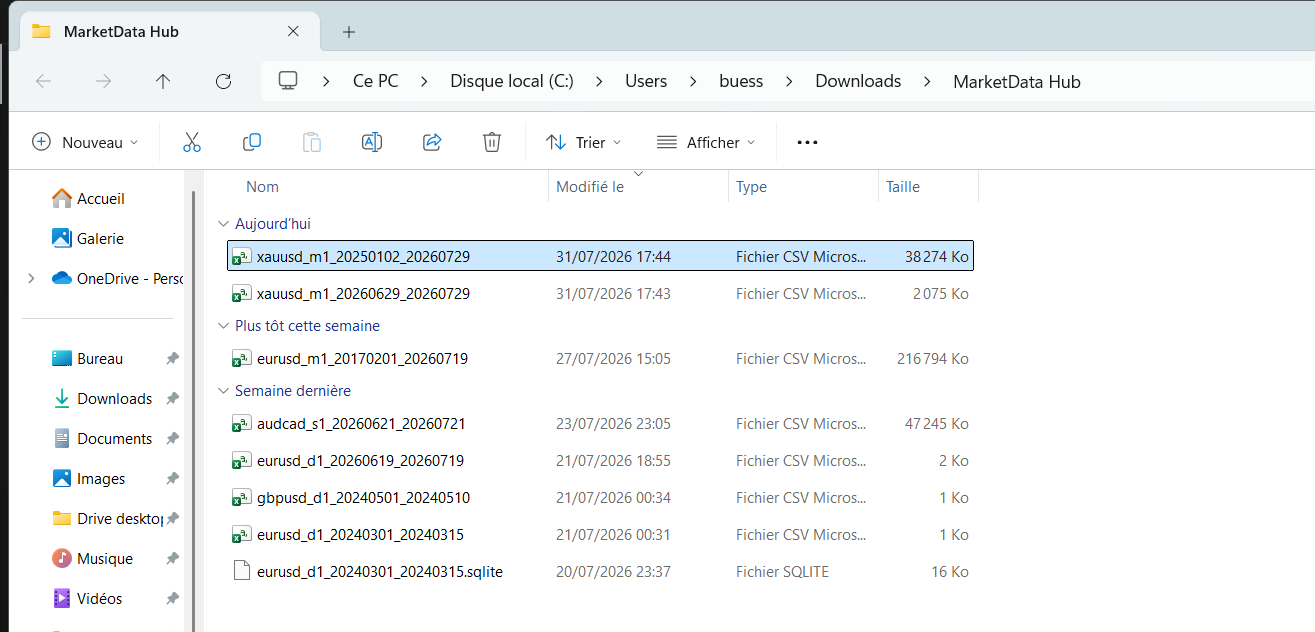
1 — Get clean, granular data
Start from accurate OHLC or tick data covering enough history to span multiple market regimes (trends, ranges, crises). Download the exact instrument and date range you need as CSV or JSON — for example EUR/USD, BTC/USD or the US 500.
2 — Match the timeframe to the strategy
Test on the timeframe you'd actually trade. Intraday strategies need 1-minute or tick data; swing systems can use hourly or daily candles. Going finer than necessary just slows the backtest — see tick vs OHLC.
3 — Avoid the classic biases
- Look-ahead bias — never let the strategy use information it couldn't have had at that bar (e.g. the bar's close before it forms).
- Survivorship bias — test on instruments as they existed historically, not just today's winners.
- Overfitting — reserve out-of-sample data; a strategy tuned to fit every wiggle of the past rarely survives live.
- Spread & slippage — model realistic costs; use bid/ask or tick data to be honest about fills.
4 — Pick a backtesting tool
- Python —
Backtrader,VectorBT,backtesting.pyor a custom pandas loop (load the CSV withread_csv). - MetaTrader 4/5 — import the history and run the Strategy Tester for EAs.
- Spreadsheets — fine for simple rule prototypes before coding.
5 — Validate and iterate
Check performance across in-sample and out-of-sample periods, multiple instruments and different market conditions before trusting a result. When you're ready, get the app and pull the history you need.
Frequently asked questions
- What data do I need to backtest a trading strategy?
- Accurate historical OHLC or tick data for the instrument and timeframe you trade, covering enough years to include several market regimes. CSV or JSON exports load into every common backtesting tool.
- Is free historical data good enough for backtesting?
- Yes, provided it is accurate and granular. The Dukascopy Bank SA archive the MarketData Hub client fetches from runs from tick level to monthly candles, which is sufficient for most retail and quantitative backtesting.
- Which timeframe should I backtest on?
- The one you would actually trade. Intraday and scalping strategies need 1-minute or tick data; swing and position strategies can use hourly or daily candles.
Related markets
- Commodities – Metals historical data · 3 instruments
- Commodities – Agriculture historical data · 6 instruments
- Indices – Americas historical data · 6 instruments
- The full catalogue · all 265 instruments
Related guides
- Loading Historical Market Data in Python (pandas, Backtrader & VectorBT)
- Querying Historical Market Data with SQL (DuckDB)
- Automating Market Data Downloads
- How to Import Historical Data into MetaTrader 4 & 5
- Importing Historical Data into NinjaTrader 8
- Historical Market Data in Excel & Google Sheets
- How to Use MarketData Hub — The Complete Guide
- Download Gold (XAU/USD) Price History
- Historical Market Data CSV & JSON Format Explained
- Download EUR/USD Price History
- How Far Back Does Historical Market Data Go?