MarketData Hub vs Dukascopy's Own Historical Export
This is the comparison where honesty is cheapest, because the data is identical by design: the MarketData Hub client retrieves from the Dukascopy Bank SA archive — the same one their own free historical export serves. You are not choosing between datasets. You are choosing between workflows.
Get the app — €9 →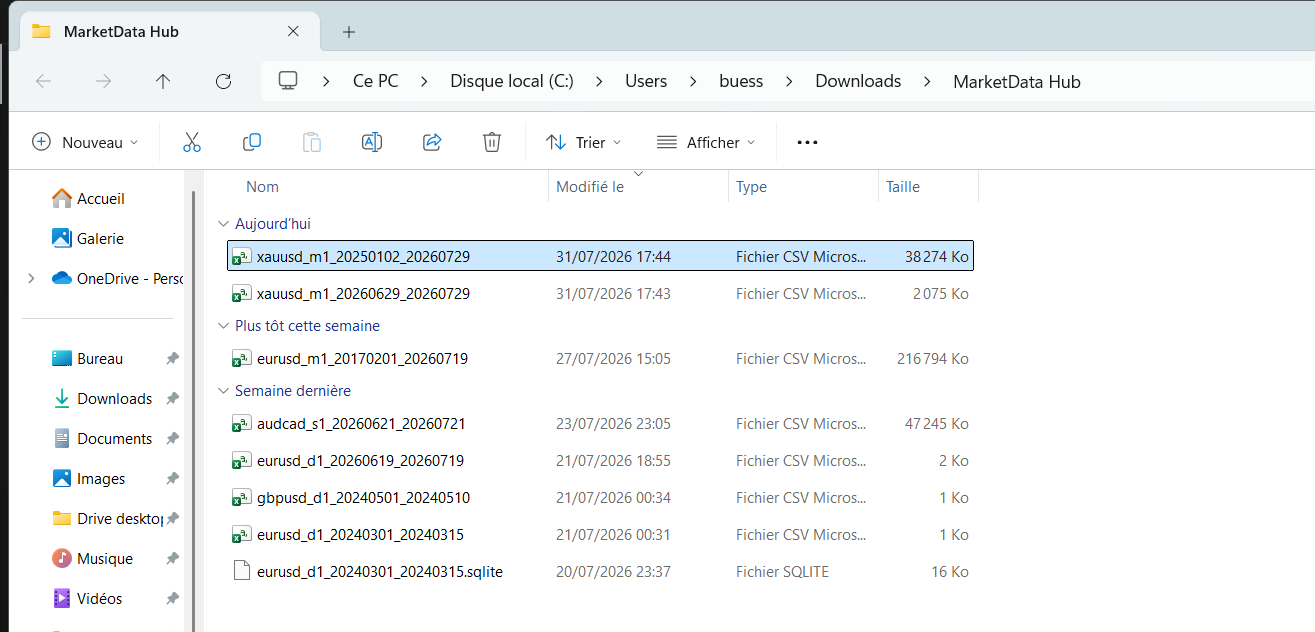
The short answer
Use Dukascopy's own export if you need a handful of series occasionally and want to spend nothing. Use the MarketData Hub client if you pull many instruments, long ranges or tick data regularly, and want queueing, resume, format choices and files that land in your folder without babysitting a browser tab.
What the official export is
Dukascopy Bank SA publishes its historical quote archive and offers a free browser-based export: pick an instrument, timeframe and range, and download the result. It is official, free, and serves the full archive. The workflow is per-request in a browser session — fine for a few series, increasingly manual as the instrument count and ranges grow.
Head to head
| Dimension | Official browser export | MarketData Hub client |
|---|---|---|
| The data itself | The same archive. Same instruments, same history — this row is a tie by construction. | |
| Price | Free | Software licence from €9, one-time |
| Workflow | One request at a time in a browser; long tick ranges typically mean several manual exports | Range-based jobs in a resumable queue; close the app mid-download and it picks up where it left off |
| Output | Download per request, assembled by hand for long studies | One file per job — CSV or JSON; MetaTrader, NinjaTrader, Parquet, SQLite on higher tiers |
| Automation | None (browser) | Headless CLI, scheduler and watch mode on the Automation tier |
| Rate behaviour | You manage your own pacing | Polite pacing, backoff and auto-resume built in — one job at a time, by design |
Why this product exists at all
Because the archive is excellent and the retrieval workflow around it is the actual cost. The client is built on dukascopy-node, the open-source library that made the archive scriptable, wrapped in an application: instrument search, per-timeframe date bounds, a queue that survives restarts, honest incomplete-download warnings and multi-format writers. If you'd rather script it yourself for free, dukascopy-node is right there — we link it because it's good.
MarketData Hub is not affiliated with, endorsed by or sponsored by Dukascopy Bank SA. The application retrieves data on your machine, under your instruction, subject to the source's own terms.
Frequently asked questions
- Is the data different from what Dukascopy serves directly?
- No — the client retrieves from the same public archive, on your machine. Same instruments, same history depth. What differs is the workflow: queueing, resume, format conversion and automation happen in the client.
- Why pay for a client when the export is free?
- Time. For a couple of series the official export is the right answer and costs nothing. The licence buys the workflow around volume: queued range-based jobs, auto-resume, multi-format output and (on the top tier) headless automation — the whole catalogue and full history on every tier.
- Is MarketData Hub affiliated with Dukascopy?
- No. MarketData Hub is not affiliated with, endorsed by or sponsored by Dukascopy Bank SA. The application retrieves data on your machine, under your instruction, subject to the source's own terms.
- Can I script the archive for free instead?
- Yes — the open-source dukascopy-node library (which this client builds on) lets anyone comfortable with Node.js fetch the archive programmatically. The client exists for people who want the same pipeline as an application rather than a scripting project.
Related markets
- Crypto historical data · 33 instruments
- Indices – Americas historical data · 6 instruments
Related guides
- How Far Back Does Historical Market Data Go?
- Best Free Sources of Historical Market Data (2026)
- MarketData Hub vs HistData (2026)
- MarketData Hub vs TrueFX (2026)
- How to Use MarketData Hub — The Complete Guide
- Download Gold (XAU/USD) Price History
- Historical Market Data CSV & JSON Format Explained
- Backtesting a Trading Strategy with Historical Data
- Download EUR/USD Price History