⚙️ Commodities – Metals Historical Data Downloader
A desktop app that downloads historical price data for 3 instruments in Commodities – Metals — metal commodities such as copper and platinum — with daily history reaching back to 2012. Every series is available from tick level up to monthly OHLC candles, fetched on your own machine and written locally as CSV or JSON, current to the last completed trading day.
Popular: High Grade Copper · Palladium · Platinum
Preview Commodities – Metals downloads →Or size one first with the file-size calculator.
One licence covers every instrument below and its entire history — tiers differ by export formats, bulk queueing and automation, never by how much data you may retrieve. Get the app · from €9, one time · Windows, macOS, Linux.
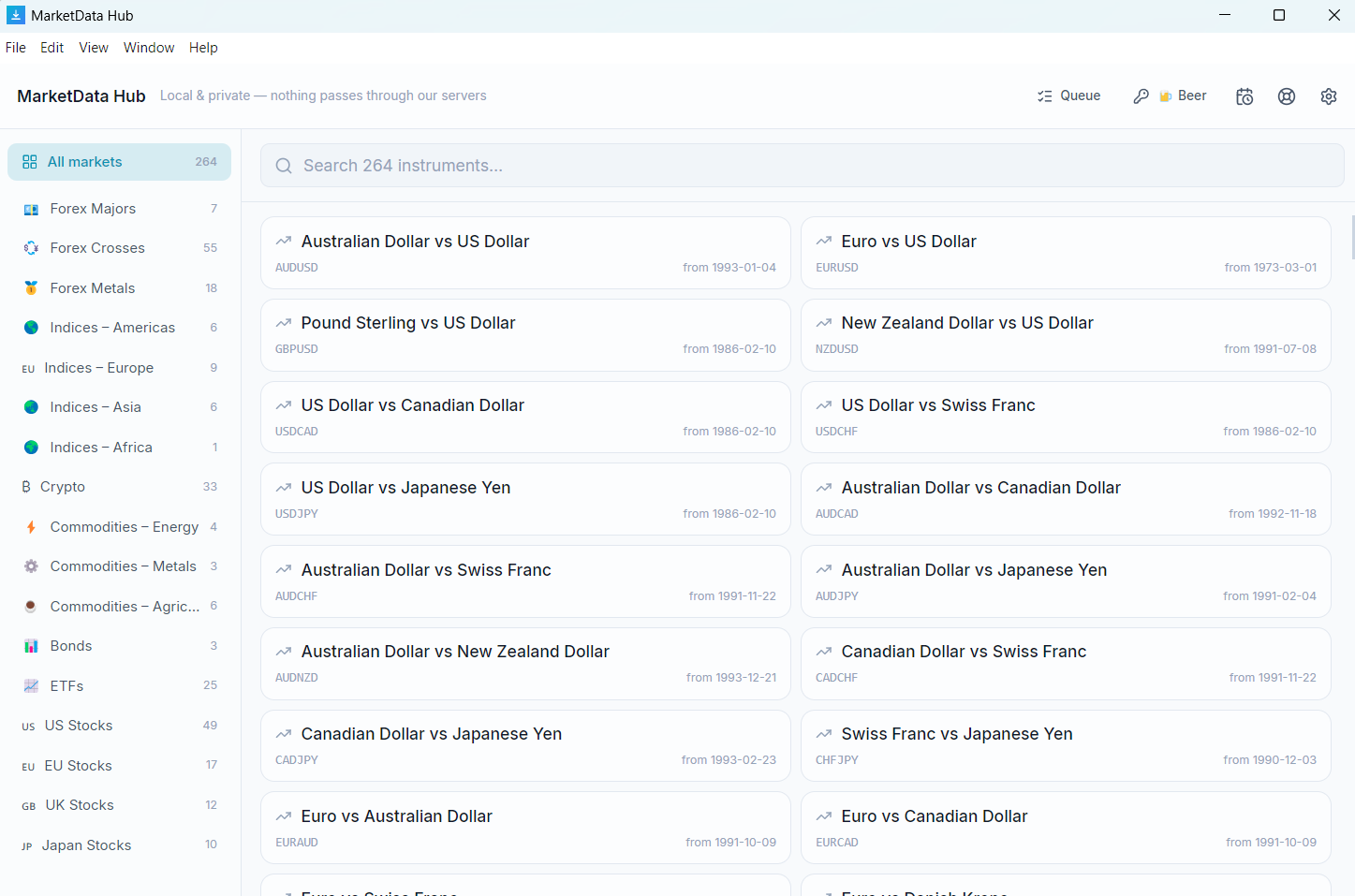
All Commodities – Metals instruments (3)
Where to start with Commodities – Metals
If you are picking a first series here, depth is usually what decides it. High Grade Copper reaches furthest back — daily candles from 2012-03-02, about 14 years — while Platinum is the most recent addition, starting 2021-11-01. The third sits between them.
Every instrument here offers quote-level tick data from the same date as its candles, so the granularity you choose does not cost you history.
Each instrument page below lists its own per-timeframe start dates, row counts and file sizes.
What a Commodities – Metals download looks like
Sizes here are driven by how much of the week the market actually trades, so they differ from other asset classes. Taking High Grade Copper as the worked example, over its full history:
| Timeframe | From | Rows | CSV size |
|---|---|---|---|
| Daily | 2012-03-02 | ~3,700 | ~183 KB |
| 1 hour | 2012-03-02 | ~87,700 | ~4 MB |
| 1 minute | 2012-03-02 | ~5.3M | ~263 MB |
| Tick (every quote) | 2012-03-02 | Far larger — usually gigabytes. Size a range before you run it. | |
Estimates at 50 bytes per CSV row, rounded. JSON runs larger; the file-size guide works through the arithmetic, and tick data vs OHLC covers which one you actually need.
Guides for Commodities – Metals
- Backtesting a Trading Strategy with Historical Data
- Querying Historical Market Data with SQL (DuckDB)
- Historical Market Data CSV & JSON Format Explained
Frequently asked questions
- How far back does Commodities – Metals historical data go?
- The deepest daily series in this class is High Grade Copper, with daily candles from 2012-03-02. Tick-level history is younger everywhere: the earliest Commodities – Metals tick data starts 2012-03-02, and the newest additions only from 2021-11-01.
- Which Commodities – Metals instruments have the longest history?
- High Grade Copper (daily from 2012-03-02), Palladium (daily from 2021-07-04), Platinum (daily from 2021-11-01). Each instrument page lists its exact per-timeframe start dates.
- Do all 3 Commodities – Metals instruments include tick data?
- Yes — every instrument here can be fetched at tick level, but each series only reaches back to its own tick start date (2012-03-02 for the earliest, 2021-11-01 for the newest listings). Always check the per-timeframe table on the instrument page before assuming intraday depth.
- When do Commodities – Metals markets trade?
- These markets trade extended weekday sessions with weekend gaps and per-market holiday closures; exact hours vary by venue. The gaps are real market structure, not missing data.